NHS must plan for heat and wildfires, says expert

 Suffolk Fire and Rescue Service
Health services should be "preparing in advance rather than reacting" to events, including heatwaves and wildfires, an academic has said.
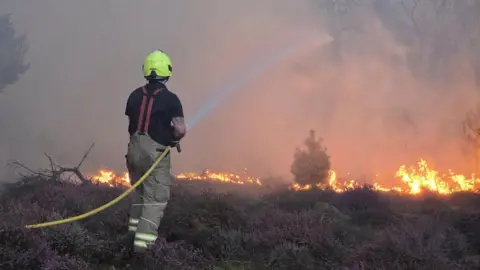
Firefighters have been tackling rural blazes across the East of England recently, most notably the ongoing major incident in Suffolk.
Environment epidemiologist Kim van Daalen, from the University of Cambridge, said health services "need clear surge plans for increases in respiratory, cardiovascular, kidney and mental health problems" linked to heatwaves and wildfires.
Health secretary Yvette Cooper said: "We are going to be increasing our planning and preparations for summer pressures just as the NHS has always done for winter pressures."
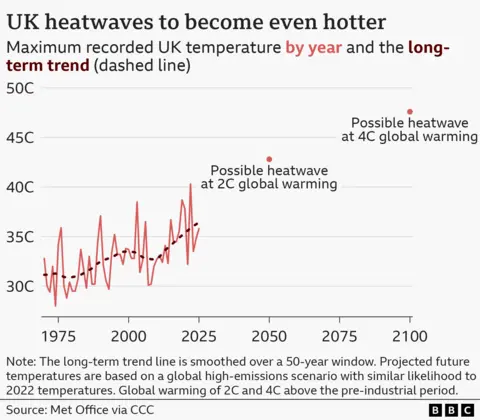
Amber heat health alerts have been issued across the East of England as temperatures are expected to rise again.
Parts of Essex, Bedfordshire, Buckinghamshire and Hertfordshire could reach 31C, while temperatures in Cambridgeshire, Peterborough, Northamptonshire, Norfolk and Suffolk are expected to reach up to 30C.
"It is also important to pay attention to heat-health alerts, which give people and health and social services time to prepare before a heatwave hits rather than reacting only once it's underway," van Daalen said.
 Kim van Daalen
Van Daalen explained that both "heat and wildfire smoke often occur together".
"Their combined effects can be more harmful than either exposure alone because they place simultaneous strain on the heart, lungs, kidneys, and our mental health."
She said climate risk could be built in to everyday care, adding: "For example, by reviewing medications and care plans for high-risk patients before summer or wildfire season begins, rather than waiting until they arrive in an emergency department.
"The most important thing is that we are preparing in advance rather than reacting to events."
Cooper said: "I have been clear that the NHS now needs to prepare for summer pressures, as well as for winter pressures, because the heat has real health consequences.
"It means all of us need to look out for elderly relatives and neighbours, and also very young children, because it is those who are vulnerable who are impacted."
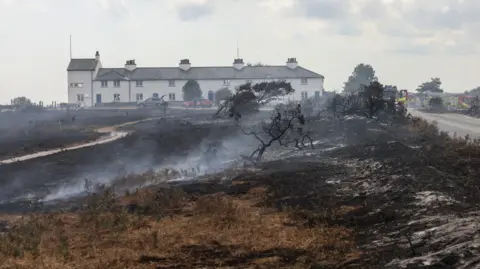
The area along the Suffolk coast went up in flames at about 17:00 BST on Wednesday, including parts of the RSPB's Minsmere nature reserve, which is home to rare birds and reptiles.
The blaze engulfed 371 acres of land (150 hectares) at its height - equivalent to the size of 210 football pitches.
More than 100 firefighters have been battling the blaze. The cause of the fire has not yet been established.
Russell Clement from the local National Trust team described Dunwich Heath as "one of the UK's most important coastal heathland landscapes".
He said in a statement: "We believe that very little heathland vegetation is left and many wildlife species will have been impacted, now and long into the future."
Van Daalen said "everyone can play a part in reducing wildfire risk" by "disposing of cigarettes and litter safely, avoiding fires in the countryside or open spaces, only using barbecues where permitted and following local fire restrictions".
She warned the following if there was wildfire smoke: "Check local air quality indexes before going outdoors, keep windows and doors closed when smoke levels are high, use air purifiers if available, and avoid strenuous outdoor activity on smoky days."
 PA Media
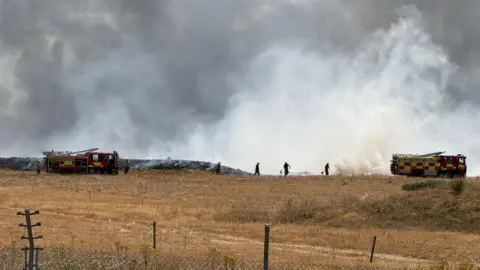
Elsewhere, about 50 firefighters attended a blaze on Ministry of Defence land near Colchester on Friday. People were asked to avoid the area and to keep doors and windows closed.
In Cambridgeshire, crews tackled wildfires at Holme Fen, near Huntingdon, Peakirk near Peterborough and at Whittlesey.
Cambridgeshire Fire and Rescue Service said it was called to more than 120 incidents between 24 and 27 July, about a quarter more than for the same dates in the past three years.
Crews across Norfolk have also been tackling several blazes, with the fire service stating that on 29 July it was called out to more than a dozen fires, including five classed as wildfires.
Farmers and residents in Northamptonshire have been asked by their fire service to help them prevent fires after it was called to 48 incidents on 28 July.
Bedfordshire Fire and Rescue sent crews to "standing crop" blazes in Dunstable, Maulden and Langford on Wednesday. One of the field fires was being investigated as "deliberate".
 Simon Dedman/BBC
Do you have a story suggestion? Contact us below.
Follow East of England news on X, Instagram and Facebook: BBC Beds, Herts & Bucks, BBC Cambridgeshire, BBC Essex, BBC Norfolk, BBC Northamptonshire or BBC Suffolk.